
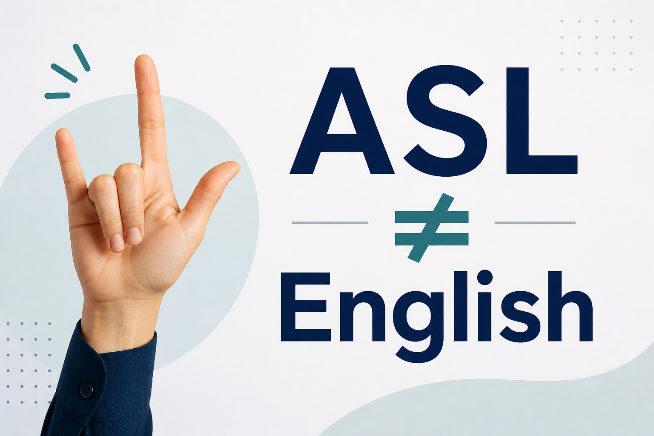
ASL and English: Why They Are Distinct Languages
It’s a common question: Is ASL the same as English? For many hearing individuals and businesses new to accessibility, the assumption is that American Sign Language (ASL) is simply English translated into signs. In reality, ASL and English are two completely different languages, each with its own grammar, structure, and cultural context.
Understanding this distinction is essential—not only for effective communication but also for organizations seeking accurate and professional sign language interpreting services.
ASL Is a Complete, Natural Language
American Sign Language is not a simplified version of English. It is a fully developed, natural language that has evolved within the Deaf community over generations. Like spoken languages, ASL has its own linguistic rules, including syntax (sentence structure), morphology (word formation), and semantics (meaning).
Research from the Linguistic Society of America confirms that ASL meets all the criteria of a true language, with a structure distinct from English and comparable in complexity to spoken languages worldwide (Linguistic Society of America, 2020).
This means that when we talk about ASL and English, we are discussing two separate linguistic systems—not one derived from the other.
Key Differences Between ASL and English
- Grammar and Sentence Structure
One of the most significant differences between ASL and English lies in how sentences are formed.
English typically follows a subject-verb-object (SVO) order:
- She is reading a book.
ASL, however, often uses a topic-comment structure:
- Book, she read.
ASL grammar also relies heavily on spatial relationships and visual context rather than word order alone. This difference is why direct, word-for-word translation between ASL and English is not effective.
According to the National Institute on Deafness and Other Communication Disorders (NIDCD), ASL uses a unique grammatical system that incorporates facial expressions and body movements as essential components of meaning—not merely as tone or emphasis (NIDCD, 2021).
- Use of Space and Visual Information
Unlike English, which is linear and auditory, ASL is visual and spatial. Signers use the space around their bodies to convey relationships between people, objects, and ideas.
For example, a signer can establish a location in space to represent a person and then refer back to that location later in the conversation. This spatial referencing has no direct equivalent in spoken English.
Facial expressions also function as grammatical markers in ASL. A raised eyebrow might indicate a question, while body shifts can show a change in subject or perspective.
- No Direct One-to-One Translation
Another misconception is that every English word has an equivalent sign in ASL. This is not the case.
Because ASL and English are fundamentally different languages, concepts are often expressed differently rather than translated word-for-word. For example, idioms in English—such as “break the ice”—do not translate directly into ASL. Instead, interpreters convey the intended meaning using culturally and linguistically appropriate signs.
This is why professional sign language interpreting services are essential in many settings, including healthcare, legal environments, and business meetings. Interpreting requires not just fluency in both languages, but also the ability to accurately convey meaning across two distinct linguistic systems.
ASL Is Not Universal
Another important point is that ASL is not a universal sign language. Different countries have their own signed languages, such as British Sign Language (BSL) or French Sign Language (LSF), each with its own grammar and vocabulary.
Interestingly, ASL is more closely related to French Sign Language than to British Sign Language, due to historical influences dating back to the early 19th century (National Association of the Deaf, n.d.).
This further reinforces the idea that signed languages develop independently, much like spoken languages.
Why This Matters for Businesses
For businesses, understanding that ASL and English are separate languages has practical implications.
Relying on written English, lipreading, or untrained individuals for communication can lead to misunderstandings and barriers for Deaf clients or employees. Lip reading, for instance, is only partially effective—studies show that even skilled lip readers may only understand about 30–40% of spoken English in ideal conditions (National Deaf Center on Postsecondary Outcomes, 2020).
Providing qualified sign language interpreting services helps ensure that communication is accurate, culturally appropriate, and accessible. It also helps organizations meet legal obligations under the Americans with Disabilities Act (ADA), which requires effective communication with individuals who are Deaf or hard of hearing.
Moving Beyond the Misconception
So, is ASL the same as English? The answer is clear: no. While both languages can express the same ideas, they do so in fundamentally different ways.
Shifting the conversation from “ASL vs. English” to “ASL and English” reflects a more accurate and respectful understanding. Each language stands on its own, with its own rules, richness, and cultural significance.
For individuals and organizations alike, recognizing this distinction is the first step toward more inclusive and effective communication.
Sources
- Linguistic Society of America. (2020). American Sign Language. https://www.linguisticsociety.org
- National Institute on Deafness and Other Communication Disorders (NIDCD). (2021). American Sign Language. https://www.nidcd.nih.gov
- National Association of the Deaf. (n.d.). American Sign Language. https://www.nad.org
- National Deaf Center on Postsecondary Outcomes. (2020). Communication Access. https://nationaldeafcenter.org