
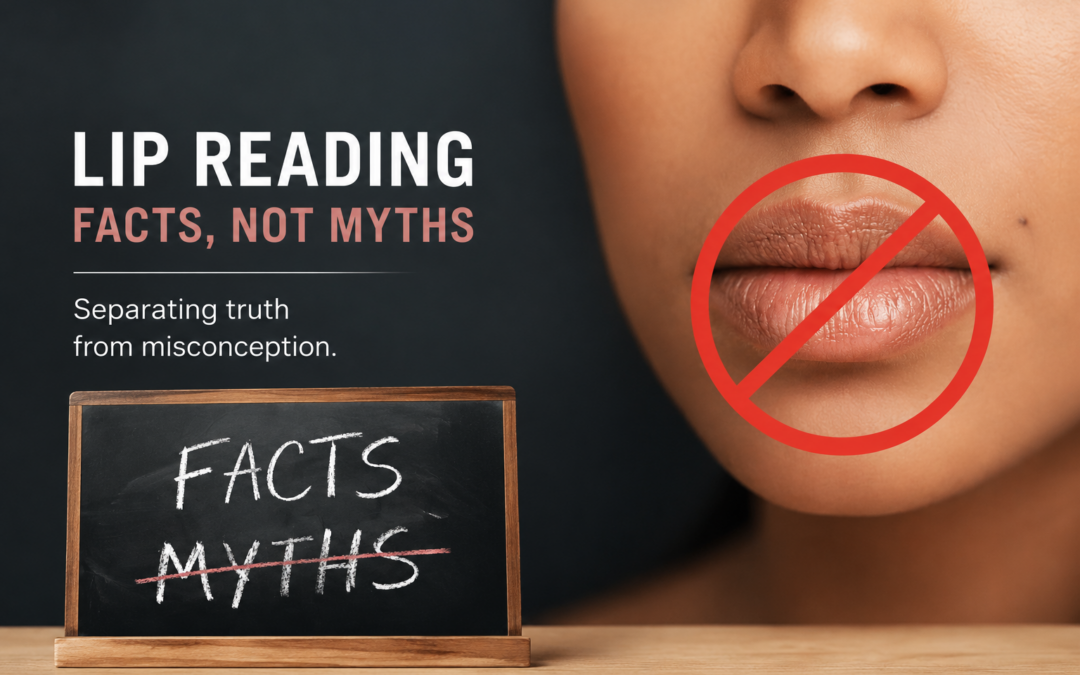
Lipreading is often portrayed in movies and television as a near-perfect method of understanding spoken language without sound. This misconception has led many people to assume that Deaf individuals can simply “read lips” instead of using American Sign Language (ASL) or professional sign language interpreters. In reality, lipreading is far from an exact science, and relying on it as a primary form of Deaf communication access creates barriers and undermines accessible communication services that are essential for true inclusion.
One of the most common myths is that lipreading is highly accurate. In truth, even the most skilled lipreaders typically understand only a small percentage of spoken words, often estimated at around 30% under ideal conditions. Many sounds in spoken English look identical on the lips. For example, “p,” “b,” and “m” share nearly identical lip shapes. Entire words or phrases can appear the same, regardless of the intended meaning. This visual ambiguity makes accurate comprehension extremely difficult without additional context.
Another myth is that any Deaf person can lipread fluently. The ability to lipread varies widely based on experience, exposure, and personal preference. It is not a universal skill, nor is it a dependable solution for inclusive communication for the Deaf community. Some Deaf individuals use lipreading as part of a broader communication strategy, while others do not use it at all. Assuming that someone “should” be able to lipread places unfair pressure on Deaf individuals and ignores the reality of how limited and inconsistent the skill can be. It also diminishes the importance of Deaf accessibility solutions and violates the principles of equal communication access.
Environmental factors also play a significant role. Effective lipreading requires perfect lighting, clear visibility of the speaker’s face, and slow, deliberate speech. Facial hair, accents, fast talking, background noise, and masks or facial coverings all interfere with lipreading. In many everyday situations such as medical discussions, classrooms, legal settings, or fast-paced meetings, these ideal conditions do not exist. Relying on lipreading sets the stage for miscommunication and exclusion.
A harmful misconception is that lipreading can replace sign language interpreters. Interpreting provides full linguistic access, capturing not just words but also tone, intent, emotion, and context. Lipreading cannot convey these important elements. Interpreters translate meaning, clarify nuance, and ensure that Deaf individuals receive accurate information in real time. In contrast, lipreading offers only fragments, requiring the Deaf individual to guess or fill in large portions of the conversation. This creates unnecessary mental strain and leads to misunderstandings.
Lipreading is especially unsafe in high-stakes settings such as healthcare and legal environments. Misinterpreting a diagnosis or legal statement can have serious consequences. Utilizing interpreting services for Deaf patients and legal interpreting for Deaf individuals ensures compliance, safety, and fairness through communication access best practices.
Finally, the myth that lipreading is easy minimizes the linguistic richness of visual languages like ASL. Deaf individuals deserve full communication access—not partial or conditional access. True inclusion requires investment in Deaf-friendly communication solutions, certified interpreter services, and ongoing Deaf inclusion and accessibility awareness.
In summary, lipreading is not a universal skill, nor is it a reliable replacement for professional interpreting. It is often inaccurate, heavily dependent on environmental factors, and insufficient for full communication access. Dispelling these myths helps ensure that Deaf individuals receive equitable, respectful, and effective communication support in every setting.