
When to Add a Certified Deaf Interpreter (CDI):
Why It’s Smart to Err on the Side of Clarity
Summary
When stakes are high or communication is complex, bringing in a Certified Deaf Interpreter (CDI) is not a luxury—it’s a quality and risk‑management decision. CDIs are Deaf professionals with specialized training and lived linguistic expertise who team with hearing interpreters to deliver clearer communicatinj—especially when language backgrounds vary, vision or tactile access is needed, or legal/medical risk is present. The ADA requires effective communication with a qualified interpreter; adding a CDI is often the most reliable way to meet that standard. RIDeCFRADA.gov
What a CDI is—and why this role exists
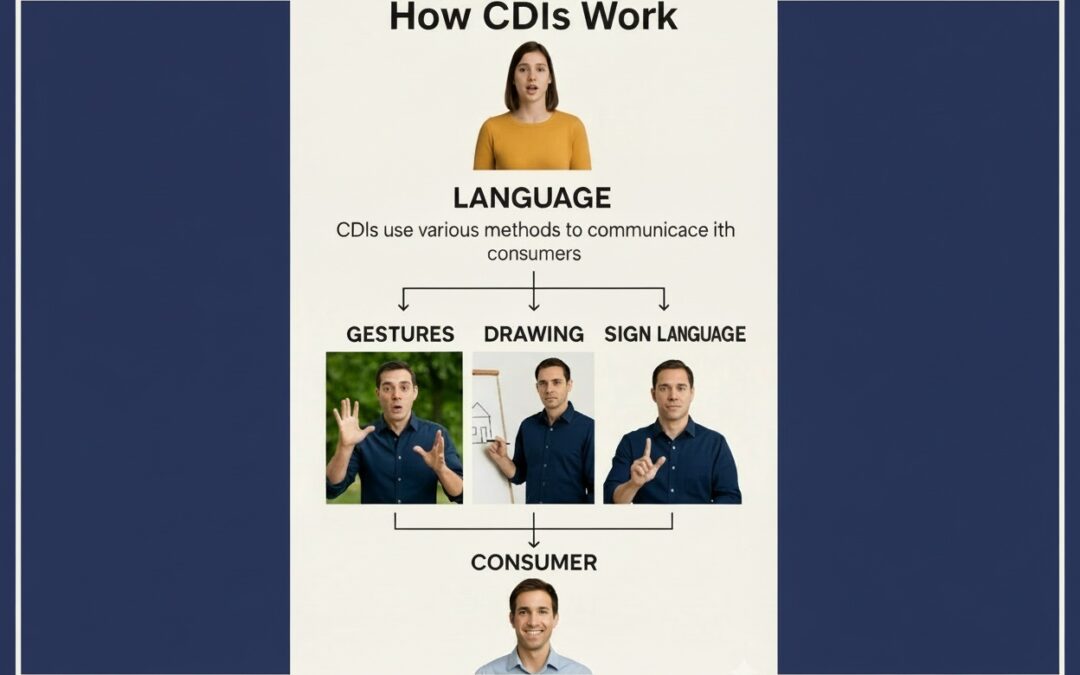
A Certified Deaf Interpreter (CDI) is a Deaf professional who has demonstrated advanced knowledge of interpreting, Deaf culture, and strategies that go beyond straight ASL/English interpretation. CDIs use methods such as visual re‑rendering, tactile/close‑vision adaptation, drawings/gestures when appropriate to bridge the gap when ASL is not enough to ensure full understanding. In practice, a CDI usually teams with a hearing interpreter, adding linguistic precision and cultural mediation that dramatically reduces ambiguity for Deaf consumers. Testing for CDI is administered through CASLI with certification conferred by RID. RIDNJ.gov
The legal standard you must meet
U.S. law doesn’t mandate “a CDI” by name, but it does require effective communication with a qualified interpreter—on‑site or via video—who can work accurately, impartially, and with any required specialized vocabulary. If the conditions suggest that teaming with a CDI is what it will take for communication to be effective, that’s the compliant choice. In healthcare, Section 1557’s 2024 rule refresh underscores “qualified” language‑access requirements and limits on using accompanying adults or minors, further raising the bar for effectiveness. ADA.goveCFR+1HHS.gov
Bottom line: When in doubt, add the CDI. It’s the low‑risk path to “qualified + effective.”
Clear signals you should add a CDI
- Varied language backgrounds: consumers who use non‑standard or emerging sign varieties; signers who sign in a language from another country; people who use signs their family made up for use in the home (home sign); signers who had no access to any language as a young child, signers with cognitive disabilities, and the like. CDIs specialize in intralingual and intersemiotic strategies (working in multiple modes of communication to ensure the message is clear) that meet people where they are. RID
- DeafBlind / low‑vision access: tactile or close‑vision interpreting which requires assistance with co‑navigation and environmental description. RID
- High‑stakes content: advising someone of their legal rights, informed consent, behavioral health, serious health situations, immigration, press briefings, emergency management—contexts where accuracy and shared understanding are mission‑critical. Courts have recognized outcome‑based effectiveness; if VRI or a single interpreter is not effective, you’re exposed to liability. Justia
Why err on the side of caution
- Risk avoidance: Misunderstandings in clinical or legal contexts can create safety events such as misunderstanding diagnosis or recommended treatments, testimony that becomes inadmissible, treatment delays, and the like. The Eleventh Circuit’s Silva v. Baptist Health decision emphasizes the result of communication, not just providing a device. Adding a CDI is a straightforward hedge against ineffective communication. Justia
- Speed to comprehension: A CDI often reduces total time to mutual understanding by eliminating repeated explanations and backtracking—especially with consumers whose first language is not ASL or English. RID
- Consumer autonomy and trust: CDI teaming improves accuracy and preserves consumer agency, which is central to “effective communication” under the ADA and HHS rules. ADA.govHHS.gov
A practical decision flow
- Screen the assignment: What’s the risk level? Who are the consumers? Any vision/tactile needs? Any multilingual sign or non‑standard signers?
- If any trigger = yes → recommend CDI.
- Consult a CDI briefly to confirm team composition and setup.
- Staff the team: CDI + hearing interpreter (most common); CDI + tactile specialist for DeafBlind; CDI‑only for Deaf‑to‑Deaf facilitation (e.g., ASL video translations). RID
- Confirm logistics: seating, sightlines/lighting, camera framing (if hybrid), turn‑taking, and—if healthcare—document how you determined “qualified + effective.” eCFRHHS.gov
- Debrief & measure: capture provider/consumer satisfaction and whether informed consent or key outcomes were achieved on the first pass.
Budgeting and contracting tips
- Add a “CDI add‑on authorization” clause in your contracts: pre‑approved when triggers are met (no extra approvals day‑of).
- Price CDI + hearing interpreter as the default in high‑risk settings; the incremental cost is small compared with reschedules, grievances, or legal exposure.
- In healthcare, align documentation with Section 1557 and internal effective‑communication policies. HHS.gov
Frequently asked questions
- Is a CDI legally required?
No. But the law requires effective communication with a qualified interpreter. If a CDI is what’s needed to be effective in context, that’s the compliant route. eCFRADA.gov - Can we rely on VRI instead?
Only if it is effective in practice; regulations set performance criteria and recognize Multiple cash settlements have verified that VRI isn’t suitable for every interaction. eCFR - Can family members interpret?
Because a family member may insert their own bias or filter out some of the communication so that the Deaf person is not receiving all the information conveyed, regulations restrict reliance on accompanying adults except in narrow emergencies; even then, it’s only very temporary until a qualified interpreter can be provided. eCFR - How do we vet a CDI?
Work with a quality interpreting agency that you trust to verify current RID CDI credential and, where relevant, check state or facility requirements.
Call to action: If you’re unsure, add the CDI. The cost is modest; the clarity and compliance are priceless.