
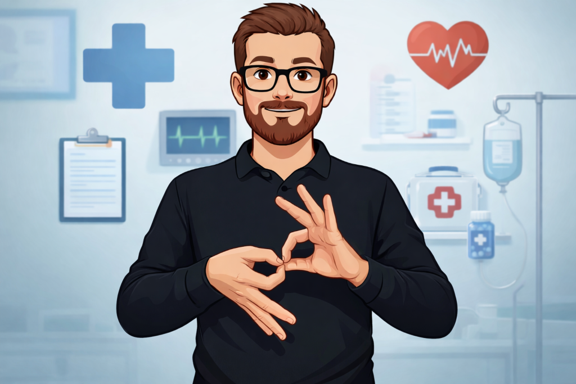
AI Sign Language Interpreters in Healthcare: Helpful Tool or Risky Shortcut?
Artificial intelligence is moving quickly into healthcare. Hospitals are experimenting with automated tools for everything from scheduling appointments to helping doctors analyze medical scans. Now, a new technology is starting to appear: AI-generated sign language interpreters, often shown as animated avatars on a screen.
The idea sounds promising. Imagine a tablet in a hospital room where a digital avatar translates spoken words into sign language for Deaf patients. Technology companies say these tools could help address the shortage of interpreters and improve communication.
But when we look closer—especially in healthcare situations—the question becomes more complicated. Communication in medical settings isn’t just about translating words. It can affect diagnosis, treatment decisions, patient safety, and privacy. So what happens if hospitals rely on AI interpreters instead of qualified professionals?
Why Communication Matters So Much in Healthcare
For Deaf and Hard-of-Hearing patients, clear communication with doctors is essential. Consider a real-world scenario: A Deaf patient arrives at the emergency room with chest pain. The doctor asks questions about symptoms, medications, and medical history. Those answers help determine whether the patient is having a heart attack or another serious condition. If the interpretation is wrong—even slightly—it can lead to misdiagnosis or delayed treatment.
Researchers studying sign languages have long emphasized that sign languages are complete natural languages with their own grammar and structure, not signed versions of English. They also reflect the culture and communication norms of the communities that use them. Because of that, accurate interpreting requires more than substituting English words with signs; it requires conveying meaning, intent, and context. What Is American Sign Language (ASL)? | NIDCD
The Promise of AI Sign Language Technology
Researchers and tech companies are developing systems that use speech recognition, machine learning, and animated avatars to translate spoken language into sign language. These systems work by:
- Converting speech into text
- Processing the text with language models
- Generating animated sign language through a digital avatar
Some studies show these systems can achieve high levels of accuracy in controlled environments. In trials of a constrained [controlled] transactional system, the average accuracy for identification of complete phrases was reported as a mere 61%…. https://www.cs.purdue.edu/homes/bb/cs590/papers/TESSA.pdf?utm_source=chatgpt.com. Would you be satisfied with understanding 61% of your doctor was saying to you? Worse yet, how much less would these numbers be in an uncontrolled setting?
Of course, in places where interpreters are truly unavailable or impractical, this technology could potentially provide basic communication support. For example: Getting directions in a train station, public announcements that are being done over loudspeakers at the airport, and the like.
The World Health Organization estimates that hundreds of millions of people worldwide live with hearing loss, which has driven interest in new accessibility technologies. So, the motivation behind these tools is understandable. But healthcare is not a train station or airport announcement, and what is at stake cannot be traded for convenience.
The Limits of AI Interpreters in Medical Conversations
Medical conversations are often complex and emotional. They involve technical terminology, patient history, and difficult decisions. It is a two-way conversation between the patient and their healthcare providers.
AI systems still struggle with:
- Facial expressions and grammar in sign language—which is critical to conveying the full meaning of a message
- Multiple speakers in a conversation
- Medical terminology and context
- Cultural nuances within Deaf communities
Studies reviewing sign-language avatar systems have found that they do not yet account for the full linguistic complexity of sign languages or the diverse ways people understand them.
In a hospital setting, even a small misunderstanding can have serious consequences. Imagine a doctor explaining surgical risks, medication side effects, or discharge instructions. These conversations require careful interpretation—not just literal translation.
The Accountability Problem
There is another issue that often gets overlooked: professional accountability. Human sign language interpreters in the United States often hold certification through the Registry of Interpreters for the Deaf (RID). Certified interpreters must demonstrate language skills, ethical decision-making, and professional standards. They are also accountable to a Code of Professional Conduct, which requires:
- Accuracy and impartiality
- Confidentiality
- Professional competence
If a certified interpreter violates these standards, there can be professional consequences, including loss of their ability to earn a living as an interpreter.
AI systems, however, are not certified. They do not pass certification exams. They may not follow professional interpreting ethics. They do not maintain continuing education or hold membership in professional registries. In short, no professional body regulates them.
Licensing Laws in Some States
Many U.S. states also require interpreters to hold a license to work in certain settings, including healthcare or legal environments. These laws exist to protect consumers and ensure interpreters meet professional standards.
An AI avatar obviously cannot apply for a license, take an exam, or be disciplined by a state licensing board. This creates a gray area: If an AI interpreter makes a serious mistake during a medical consultation, who is responsible? The hospital? The software company? The doctor? Right now, there is no clear answer.
Privacy and HIPAA Concerns
Healthcare communication is also governed by strict privacy laws. The Health Insurance Portability and Accountability Act (HIPAA) requires healthcare providers to protect patient information. When a human interpreter works in a hospital, they must follow confidentiality rules and professional ethics.
But with AI systems, patient information may be processed by cloud servers, stored in data logs, and/or transmitted through third-party software platforms. This raises concerns about how patient conversations are stored, protected, or potentially reused. In other words, the technology that translates a conversation could also be collecting, and sharing, sensitive medical data.
What Deaf Patients Often Say They Want
Across research and community discussions, many Deaf individuals say they support technology—but not as a replacement for professional interpreters. Technology can be useful for:
- Quick communication
- Simple questions
- Situations where no interpreter is available
But in high-stakes environments like healthcare, people often prefer qualified human interpreters who understand both language and culture. This includes professionals such as: Certified sign language interpreters, Certified Deaf interpreters, and CART captioners. These professionals are trained not just in language, but in communication accuracy, ethics, and patient understanding.
Technology Should Support, Not Replace
AI sign language systems may eventually become helpful tools in healthcare settings. They might assist interpreters, provide basic communication access, or help fill temporary gaps. But replacing trained interpreters entirely raises serious concerns about patient safety, privacy, legal accountability, and quality of communication
Healthcare decisions can be life-changing. When patients are discussing surgery, medication risks, or diagnoses, communication must be clear, accurate, and trustworthy. Right now, AI still has a long way to go before it can replace the experience, cultural understanding, and ethical responsibility that human interpreters bring to medical conversations.
The Bottom Line
Technology can improve accessibility—but only when it respects the real needs of the people it serves. For Deaf and Hard-of-Hearing patients, healthcare access is not just about translating words. It’s about trust, safety, and understanding. AI may be a useful tool in the future. But when it comes to medical care, many people still believe that human expertise should remain at the center of communication.