
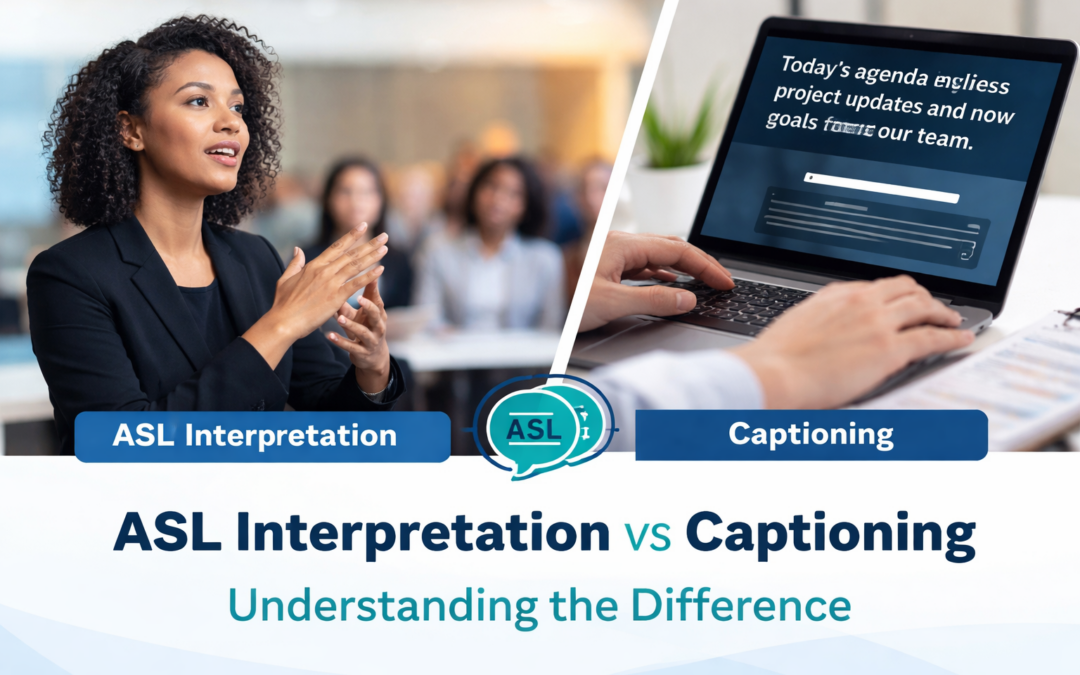
Why Captioning is not the same as ASL Interpretation
When providing communication access for Deaf individuals, it is essential to understand that ASL interpretation and captioning are not the same service. While both are accessibility tools, they function differently, rely on distinct skills, and meet different language needs. Confusing or substituting one for the other can unintentionally create barriers rather than access.
Understanding the difference between ASL interpretation vs captioning helps organizations, educators, and event planners choose the right service and demonstrate a genuine commitment to inclusion.
What Is ASL Interpretation?
ASL interpretation involves a trained professional who conveys information between spoken language (such as English) and American Sign Language (ASL) in real time. ASL is a complete, visual-spatial language with its own grammar, syntax, and cultural norms—it is not a signed version of English.
Professional ASL interpreters do more than translate words. They interpret meaning, tone, intent, and context using hand shapes, facial expressions, body movement, and spatial referencing. This allows Deaf participants to fully engage in live meetings, classrooms, medical appointments, conferences, and events.
For many Deaf individuals, ASL is their primary language, making ASL interpretation the most natural and effective form of communication access.
What Is Captioning?
Captioning provides access by converting spoken language into written text displayed on a screen. This can include real-time captioning, such as CART (Communication Access Realtime Translation), or pre-recorded captions used in videos and presentations.
Captioning focuses on transcribing spoken words into text. While it can be effective for individuals who are fluent readers of English, it does not convey the linguistic structure, cultural meaning, or visual nuances of ASL. Elements such as emphasis, emotion, and intent may be reduced or lost in text-based formats.
ASL Interpretation vs Captioning: Key Differences
One of the most important differences between ASL interpretation and captioning is language modality.
ASL interpretation provides access through a visual language, which aligns with how many Deaf individuals naturally process information. Captioning relies on reading comprehension of a spoken language, which may be a second language for some Deaf people.
Because of this, ASL interpretation often allows for faster, clearer, and more accurate comprehension for ASL users compared to reading captions.
Interaction and Engagement in Real Time
Another major difference is interaction.
ASL interpretation supports two-way communication, allowing Deaf participants to ask questions, respond, and actively engage in discussions in real time. This is especially critical in meetings, classrooms, trainings, and Q&A sessions.
Captioning is primarily one-way. While it provides access to spoken information, it does not facilitate the same level of immediate, dynamic interaction. In live environments, relying on captions alone can limit participation for ASL users.
When ASL Interpretation and Captioning Work Together
In some situations, ASL interpretation and captioning can complement each other. For example, conferences or public events may offer both services to accommodate a range of language preferences and access needs.
However, these services are not interchangeable. Providing captions instead of ASL interpretation for an ASL user can significantly reduce comprehension and engagement. Accessibility decisions should always be based on the language preferences and needs of Deaf participants.
Choosing the Right Accessibility Service for Deaf Access
Organizations, educators, and event planners should avoid assuming that captioning alone is sufficient. For many Deaf individuals, especially those who use ASL as their primary language, ASL interpretation is essential for full access.
Choosing the appropriate service—whether ASL interpretation, captioning, or both—shows respect, supports equity, and creates truly inclusive environments.
Why Understanding the Difference Matters
ASL interpretation and captioning are distinct accessibility services, each with specific strengths. ASL interpretation delivers meaning through a visual language, enabling full participation and engagement, while captioning provides a textual representation of spoken language.
Understanding the difference between ASL interpretation and captioning ensures that Deaf individuals receive the most effective communication access—supporting comprehension, interaction, and inclusion in every setting.